Skip to content
Features

Everything a job work chain
actually needs

Four operations run the whole business. Each one is built around how job work actually happens on the floor, not a generic inventory module with the names changed.

Two ways to run it

Not every chain plans its work, and WON does not insist

Both modes move material on the same challans, answer to the same return clocks and file the same ITC-04. What differs is whether the work is planned before it happens or stated after it.

Full production cycle

You plan the work

Jobs and operations lay out the route across your job workers, and a production run at each stage records what was issued and what came out against a locked recipe. Yield, stage times and end-to-end closure are measured from what was actually posted.

Suits a chain where the recipe matters and you want the numbers measured against it.

Stock movement only

You don't

Material moves on delivery challans exactly as it does above, but nothing plans the work. Each job worker states what it consumed and what came out, and you see the result against the material you own. No recipes, no production runs, no routing.

Suits a chain where the job workers already know their process and you need to know where your material is and what became of it.

A workspace is set to one of these and can be switched later. Switching hides the screens the other mode uses; it never deletes what they hold, so switching back brings them all back.

The four operations

What the product actually does

Each one is a screen somebody uses every day, not a capability on a slide.

01

Inventory transfers

Move material with the right paperwork, every time

Every time material moves between Company 1 and a job worker, or between two job workers, WON creates the transfer record, decides whether an e-way bill is legally required, and generates the delivery challan automatically. Nobody has to remember the rules for a specific state or a specific value threshold; the system applies them consistently, every time.

  • Delivery challans generated per movement, in the correct triplicate format
  • E-way bill requirement decided automatically by value, distance and state rules
  • In-transit stock tracked separately from stock that has actually been received
  • Full ledger history per location, viewable at any point in time
  • Support for consolidated e-way bills when multiple consignments travel together
  • Every transfer traceable to what triggered it, whether that is a production run or a job worker simply stating what it did
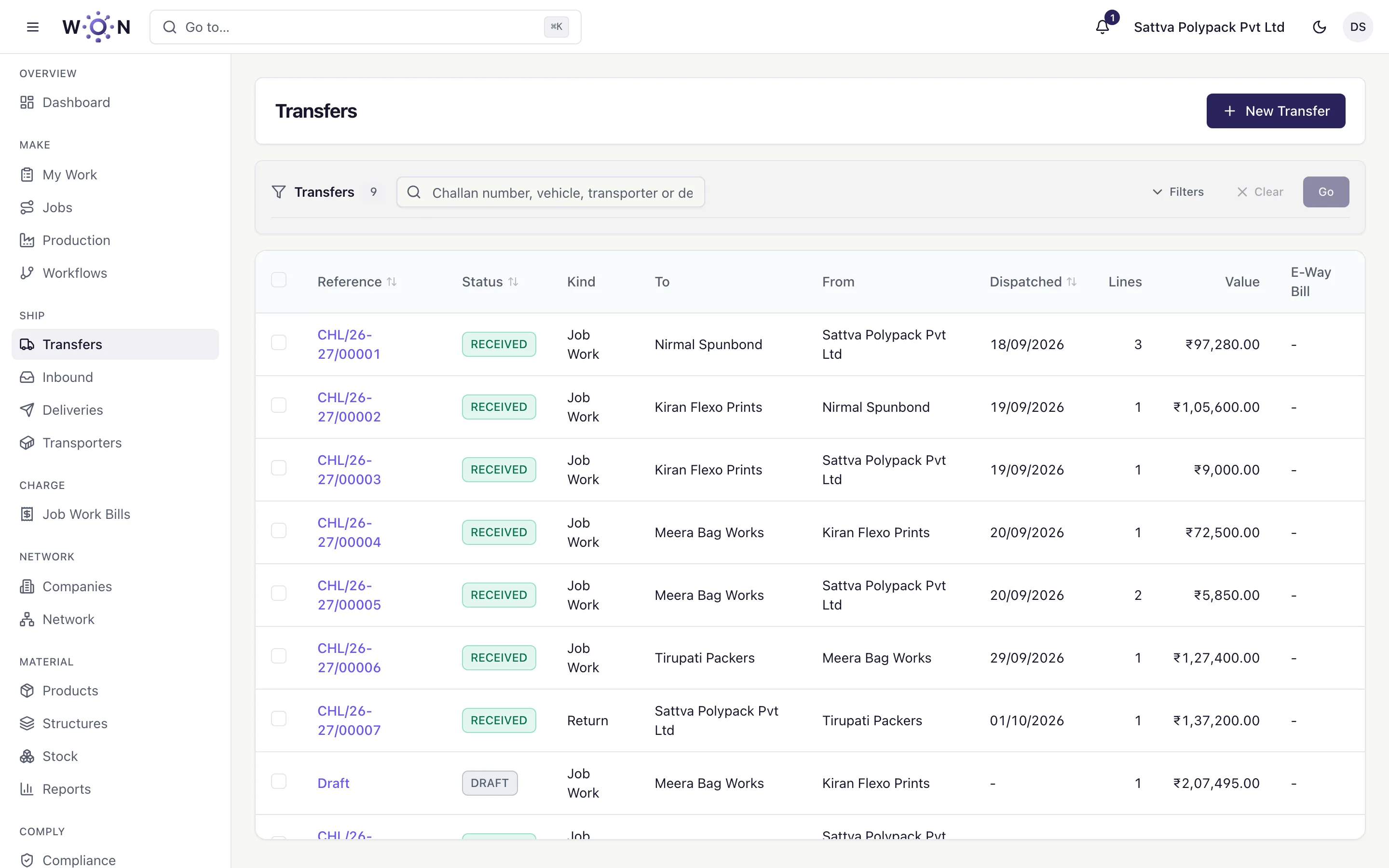
The Transfers list in WON: nine delivery challans between Sattva Polypack and its four job workers, each with its reference number, status, who sent it, who received it, the dispatch date and its value in rupees.
Every transfer, with its challan and e-way bill status, in one screen

02

Manufacturing

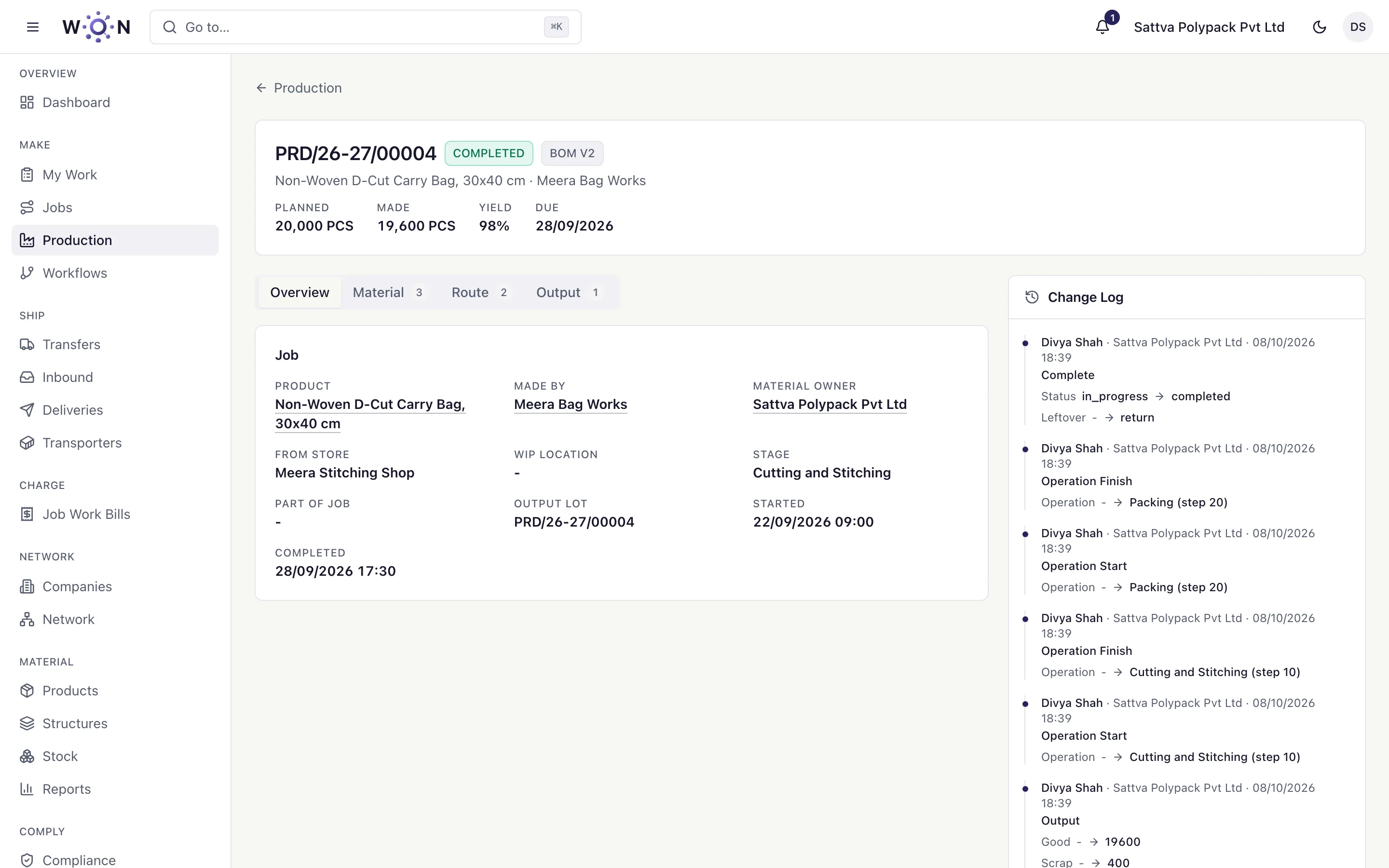
Every stage runs against one locked recipe

Company 1 defines the recipe once, at every stage of the chain, and that exact version travels with the material. A job worker cannot accidentally produce against an old or unofficial version, because WON locks the recipe the moment a production run starts. Production can be tracked by lot, by serial number, or simply by quantity, depending on what the product actually needs.

  • Multi-level, version-locked recipes with scrap and yield factors built in
  • Track by lot, serial, or quantity, chosen per product
  • Optional barcode or QR label printing at any stage of production
  • Full genealogy from a finished lot back to the original raw material lot
  • Production entries logged with operator, timestamp and quantity produced
  • Rejects and scrap recorded separately from good production
A completed production order in WON, showing the recipe version it was pinned to, what was issued against it, and what came out as good, rejected and scrapped.
Production logged straight against the locked recipe

03

Deliveries

Ship in stages, plan ahead, let Company 1 decide the route

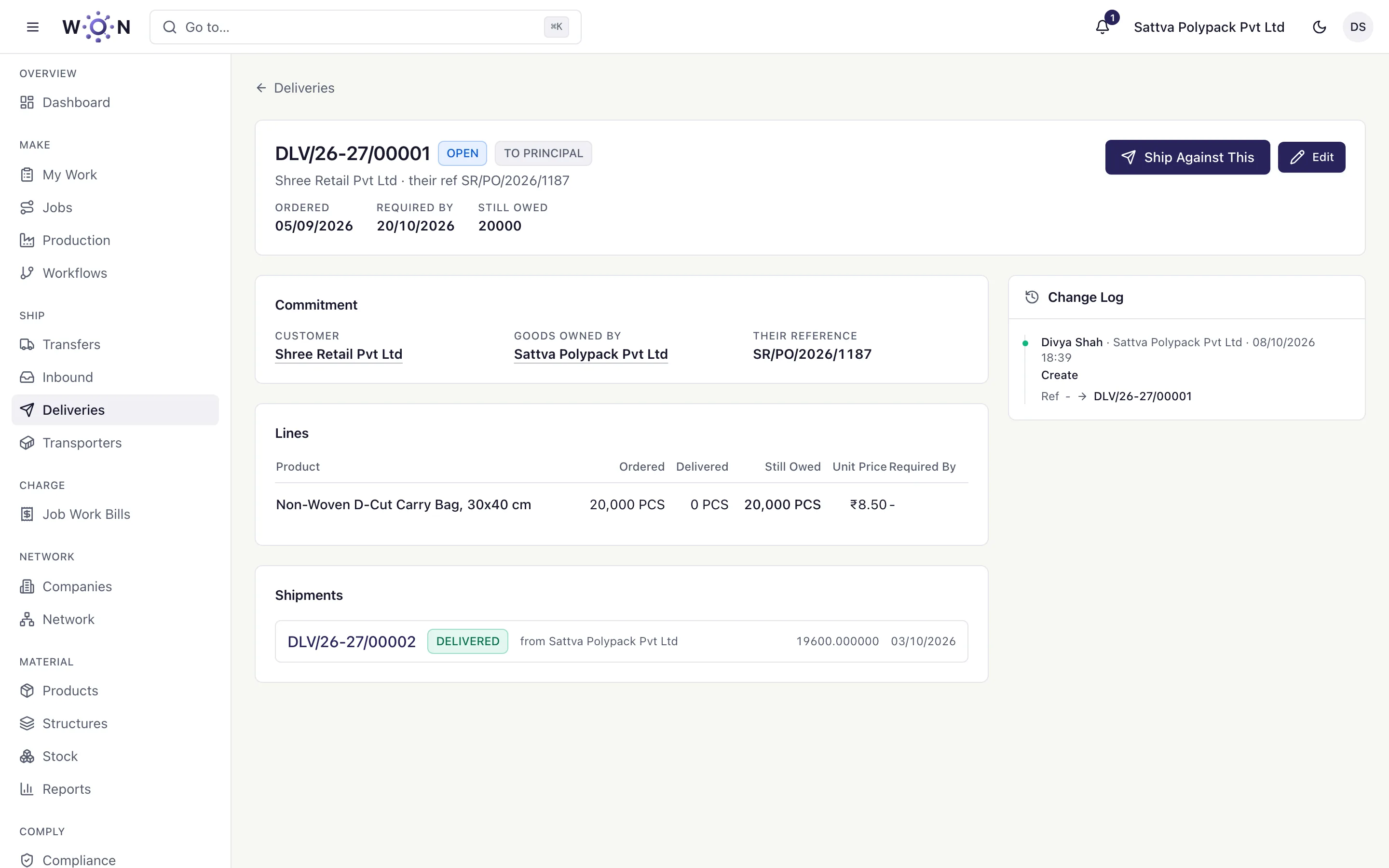
Not every order ships in one go. WON supports partial and multiple deliveries against the same order, so a job worker can dispatch what is ready without waiting for the full quantity. Company 1 keeps control of the final decision: does the finished product come back to Company 1's own warehouse, or does it go straight to Company 1's customer.

  • Multiple, partial deliveries against a single order, with the balance tracked automatically
  • Advance planning with scheduled dispatch dates
  • Route the finished product back to Company 1, or drop-ship to Company 1's customer
  • Invoice on the platform, or attach one issued externally along with a physical e-way bill
  • Delivery status visible to every party in the chain, without a phone call
  • Backorder and open balance tracked until an order is fully delivered
A delivery plan in WON: the customer, the promised date, and the finished goods lines waiting to be routed into a despatch.
Plan a delivery and route it in a couple of clicks

04

Internal returns

Rework and surplus, never confused with customer returns

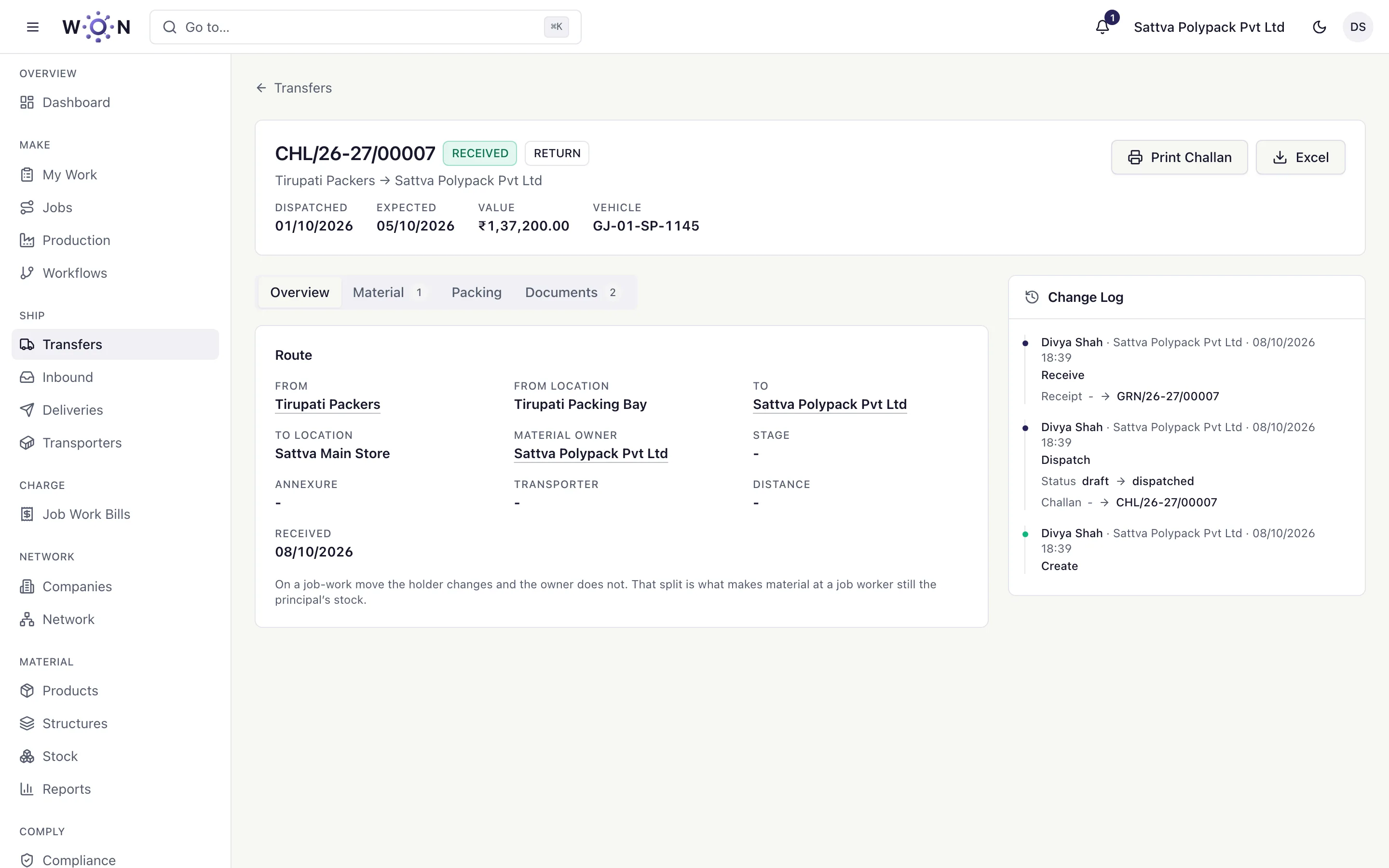
Material sometimes needs to move backward through the chain: a batch gets rejected, a job worker sends back surplus, or something needs rework at an earlier stage. WON treats these as internal returns, entirely separate from any return coming from Company 1's end customer, and links every internal return back to the original outward challan so there is a clean audit trail.

  • Job worker to job worker returns only, clearly separated from customer returns
  • Linked to the original outward challan for a complete audit trail
  • Return clock alerts before the one year or three year GST deadline is at risk
  • Reason codes for rework, rejection, surplus and scrap
  • Ledger updated immediately at both the sending and receiving location
  • Reports on return volume by job worker, to spot recurring quality issues
A return challan in WON, sent from the last job worker back to the principal, showing the material returned and the original outward challan it answers.
A return, linked back to the original challan automatically

Supporting features

The features that hold the four operations together

None of these are add-ons bolted on later. They are part of how every transfer, production run, delivery and return already works.

Notifications

Every stage can trigger a notification, and you decide exactly what gets sent, to whom, and when, across email, in-app alerts and WhatsApp. A job worker can get a WhatsApp message the moment material is dispatched to them. Company 1 can get an email the moment a return clock crosses eleven months. Nothing is sent that you have not configured.

Masters and parameters

Currency, date format, decimal precision, tax codes, GST state codes and unit of measure all come from configurable master data, never from hardcoded values. This is what lets the same product run for a manufacturer in India and one outside it, without a separate build for each country.

Analytics

See exactly how material flows through your chain, how long each stage actually takes, and where a bottleneck is quietly slowing everything down. Reports are built directly off the same ledger that runs the operations, so the numbers always match what is actually happening on the floor.

Company network

Company 1 can add job worker companies directly, with their full details already on file, or send an invitation link and let each job worker complete their own registration. Either way, every company keeps its own login and its own view of the chain.

Get started

See these features on your own chain

Registration takes about two minutes, and the free plan runs one chain end to end. Invite your job worker partners when you are ready. They never pay.

Free to start. No card required.